Executive Summary: The Digital Authorship Dilemma in 2026
Across higher education, digital publishing, and editorial newsrooms, a profound crisis of miscommunication has emerged. Educators, editors, and students routinely conflate two fundamentally different phenomena: plagiarism and AI-generated content.
A student receives an email with the dreaded subject line: "Issue with your essay submission." Their immediate reaction is panic—have they been accused of academic theft? In reality, their originality scanner found a 0% plagiarism match, but an automated probabilistic detector flagged a "78% AI probability" score. Similarly, web publishers striving for Google AdSense monetization frequently ask whether Google penalizes artificial intelligence or classifies it as duplicate content.
Fundamental Definitions: Attribution Theft vs. Probability Modeling
To navigate the modern landscape of digital authorship, one must establish clear, non-negotiable boundaries between these two concepts.
1. What is Plagiarism?
Plagiarism is the act of presenting someone else's work, concepts, research, or phraseology as your own without appropriate credit or citation. Plagiarism is an ethical and often legal violation rooted in copyright and intellectual property.
- Verbatim Plagiarism: Copy-pasting text directly from an existing website, book, or paper without quotation marks or source attribution.
- Patchwriting: Slightly shuffling a few synonyms into someone else's original sentence while retaining their unique syntax and underlying argument.
- Idea Theft: Summarizing a researcher's novel hypothesis or proprietary framework without crediting the originating institution.
2. What is AI-Generated Content?
AI-generated text is produced by Large Language Models (LLMs) such as Google Gemini, Claude, and ChatGPT. These neural networks do not copy and paste from an internal database. Instead, they predict the most statistically probable next token (word or sub-word) based on patterns learned across massive training datasets.
Because an LLM generates novel sequences of words mathematically in real time, pure AI content is almost always 100% original from a string-matching perspective. It will easily pass traditional plagiarism scanners with a 0% similarity score. However, its predictable linguistic rhythm frequently triggers statistical AI detectors.
Under the Hood: How the Detectors Actually Work
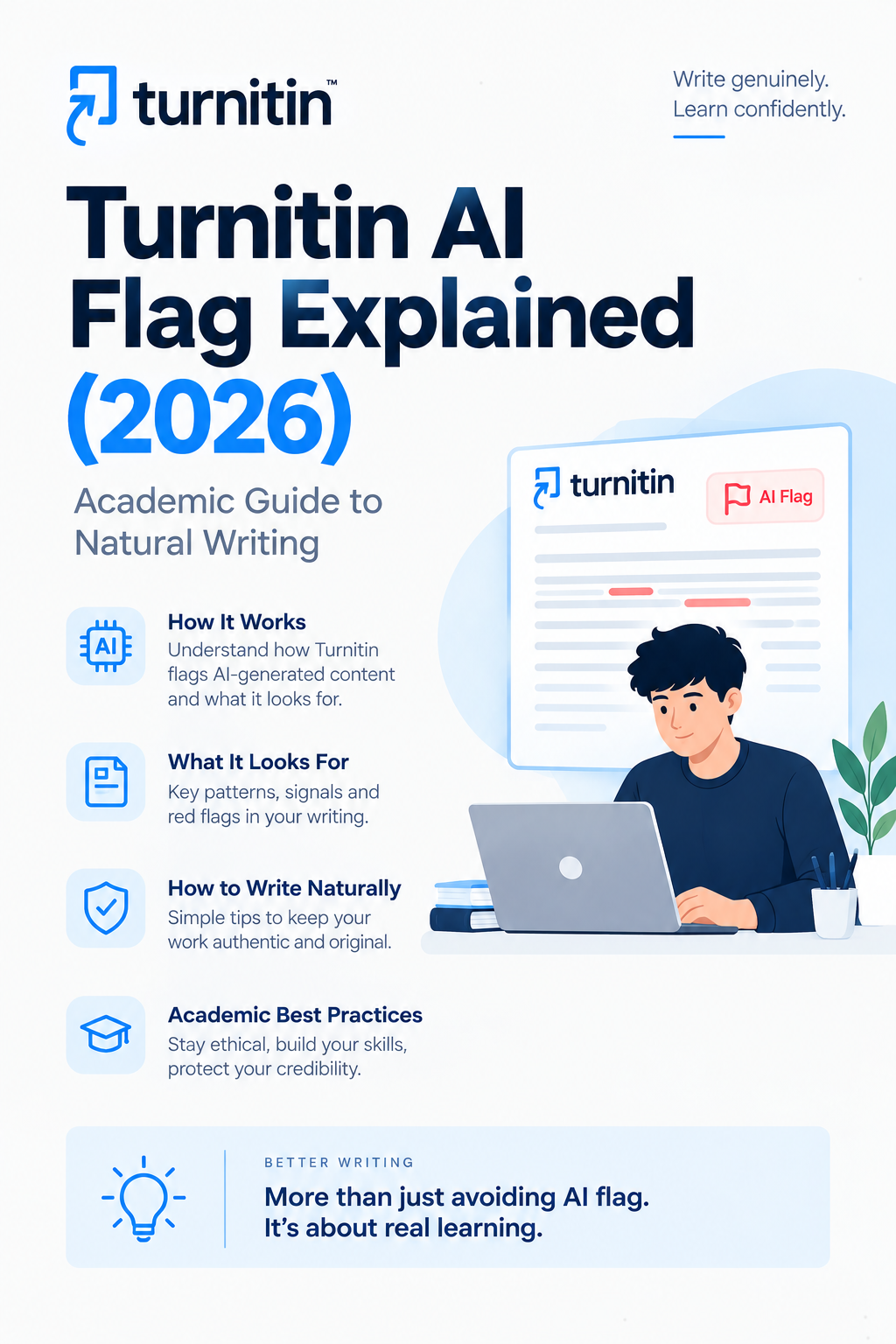
The confusion between plagiarism and AI flags largely stems from institutional interfaces like Turnitin, where a single dashboard displays both a "Similarity Score" and an "AI Writing Indicator." Despite sharing a dashboard, their underlying algorithms could not be more divergent.
Traditional Plagiarism Scanners (String Matching)
Tools such as Turnitin Similarity, Copyscape, and Unicheck use deterministic string-matching and n-gram fingerprinting:
- They compare the submitted text against a historical index of billions of active and archived web pages, published academic journals (IEEE, PubMed, JSTOR), and private student paper repositories.
- They search for contiguous strings (typically 7 to 10 identical consecutive words).
- Output: An exact, verifiable highlight showing the precise URL or source document where the text previously appeared.
AI Detection Classifiers (Statistical Probability)
Tools such as Turnitin AI Writing, GPTZero, Copyleaks, and Originality.ai use probabilistic machine learning models:
- Perplexity: A measure of how "surprised" a language model is by the author's choice of words. If every word selected is the mathematical #1 most probable next token, perplexity is low, which detectors interpret as synthetic.
- Burstiness: The variation in sentence length, structure, and emotional cadence across a document. Humans write with high burstiness—pairing a short, punchy sentence with a long, multi-clause exploratory thought. AI models tend to produce uniform, metronomic sentences of 18–24 words.
- Output: A probability estimate (e.g., "82% likely generated by AI"). It is not evidence; it is a statistical guess that cannot cite an original source.
The Comprehensive Comparison Matrix
The table below summarizes the critical technical, ethical, and practical distinctions between plagiarism and AI content flags:
| Feature / Dimension | Plagiarism | AI-Generated Content |
|---|---|---|
| Core Nature | Ethical & attribution violation (theft of human credit) | Linguistic pattern (synthesized statistical output) |
| Verification Method | Deterministic string matching (n-gram comparisons) | Probabilistic classification (perplexity & burstiness) |
| Proof of Origin | Definitive: Highlights the exact source document & URL | Theoretical: Offers a confidence score without source evidence |
| False Positive Risk | Near zero for distinct phrases (excluding common idioms) | High (15%–30%): Especially on formal, technical, or ESL writing |
| Academic Consequences | Formal disciplinary hearings, course failure, expulsion | Contested policies; many universities ban punitive action based solely on AI scores |
| Google Search Status | Direct penalty for scraped/duplicate content | Fully allowed if helpful, original, and value-additive (E-E-A-T) |
| Remediation Path | Proper quotation marks, citations, and re-attribution | Humanizing syntax, adding personal insights, varying cadence with Zero AI |
The False Positive Crisis: Why Real Human Writers Get Flagged
One of the most damaging aspects of the AI detection craze is the high rate of false positives against honest human writers. Understanding why this happens protects authors from unfounded accusations.
1. The ESL (English as a Second Language) Penalty
Pioneering computational studies from Stanford University revealed that AI detectors disproportionately flag non-native English speakers. Writers who learn English as an additional language tend to rely on standardized grammatical structures, common transitional words ("Moreover," "Furthermore," "In conclusion"), and conservative vocabulary. Because these choices match high-probability statistical patterns, automated detectors mistakenly label authentic human effort as machine output.
2. The Academic Formalism Trap
Scientific and academic writing standards demand objectivity, third-person perspective, and uniform clarity. When a researcher writes, "The experimental data demonstrates a statistically significant correlation between...", they are adhering to rigorous academic standards. Paradoxically, because AI models were heavily trained on scientific abstracts, scholarly rigor is mistaken for algorithmic generation.
Google's Official Stance & AdSense Approval Criteria
Digital publishers, affiliate marketers, and bloggers frequently worry that using AI tools will trigger an algorithmic penalty from Google or result in immediate rejection by Google AdSense. Let us dispel the myths with Google's official documentation.
"Our focus on the quality of content, rather than how content is produced, is a useful guide that has helped us deliver reliable, high quality results to users for decades... Appropriate use of AI or automation is not contrary to our guidelines."
— Google Search Central Documentation on AI-Generated Content
Why AdSense Rejects Low-Quality AI Sites (And How to Pass)
Google AdSense does not reject websites simply because AI was used during the drafting process. AdSense rejects websites for a specific policy violation called "Low-Value Content". Here is the vital distinction:
- What Gets Penalized: Scraping hundreds of generic ChatGPT summaries, publishing them without editorial review, offering zero original analysis, and creating thin affiliate bait designed solely to game search algorithms.
- What Gets Approved: Comprehensive, well-structured guides that provide genuine utility, solve user pain points, feature first-hand perspectives or case studies, and present human-readable flow with clear typography.
Actionable Protocol: Ensuring 100% Integrity in Your Writing
Whether submitting a master's thesis or launching an authoritative content hub, adhere to this four-step authorship protocol:
Step 1: Forensic Citation Hygiene (Zero Plagiarism)
Never rely on memory when referencing data, quotes, or conceptual frameworks. Always cite the originating DOI, publication, or author. When paraphrasing, re-articulate the concept through your own mental synthesis rather than swapping individual adjectives.
Step 2: Injecting Syntactic Burstiness
Break the robotic metronome. Review your paragraphs and intentionally introduce rhythm variations:
- Follow an elaborate, analytical sentence with a short, three-word statement.
- Use rhetorical queries.
- Incorporate parenthetical thoughts or real-world anecdotes that an LLM would never organically synthesize.
Step 3: Refine with Huminify Zero AI
If you use modern AI tools to brainstorm or compose preliminary drafts, utilize Huminify's Zero AI engine to humanize the output. Powered by direct client-side neural processing via Gemini 2.5 Flash, Huminify strips away formulaic robotic transitions ("Delve into," "testament to," "game-changer") and restores natural perplexity and authentic human burstiness.
Step 4: Maintain an Immutable Version History
Always write or edit using tools that preserve timestamped revision histories (such as Google Docs Version History, Microsoft Word Track Changes, or Git commits). If an automated classifier ever questions your originality, presenting a continuous, keystroke-level editing trail provides indisputable proof of human authorship.
Frequently Asked Questions
Can an AI detector prove that a student cheated?
No. By definition, AI detectors generate probabilistic scores, not verifiable evidence. Unlike plagiarism detectors—which present exact matching text alongside the original published source—an AI detector cannot point to a source document. Because false positive rates remain high, an AI score serves at most as an invitation for an academic discussion, never as definitive proof of misconduct.
If I ask ChatGPT to rewrite my own original notes, is that plagiarism?
No, that is not plagiarism because you are not taking someone else's intellectual property. However, depending on institutional rules, it may fall under guidelines regarding "unauthorized assistance" or trigger automated AI classifiers due to the resulting statistical predictability.
Does Google AdSense have an automated tool that rejects AI text?
No. Google's evaluation systems assess content helpfulness, visitor engagement, site architecture, and user experience. Websites created with AI assistance that provide original analysis, high readability, and genuine user value are routinely approved for AdSense every day.
How can I test my content before submitting or publishing?
First, run your text through a reliable plagiarism checker (such as Copyscape or your university's submission portal) to ensure zero duplicate strings. Next, review the sentence burstiness and cadence. Using Huminify's Academic or University modes ensures that your ideas are expressed with authentic scholarly cadence while eliminating synthetic linguistic flags.
Researched & Written by Yogesh Singh
E-E-A-T VerifiedAuthored by the Huminify Editorial & Linguistics Team (Founder & AI Systems Lead). Our technical guides are peer-reviewed against real-world AI detection models, Google Search Quality Evaluator Guidelines, and academic integrity policies to deliver actionable, truthful insights.
Refine and Naturalize Your Writing with Huminify
Transform mechanical, repetitive AI drafts into clear, authentic human writing with natural flow and rhythm. 100% free with your own Gemini API key.